
Criminal Court Records in Charles County
A criminal court record is the court-maintained file for a prosecution. It begins when a charging document is filed with the court and then grows as the case moves through hearings, motions, plea negotiations, trial, disposition, sentencing, probation, restitution, and post-judgment activity. It is different from the arrest record created by the Charles County Sheriff's Office or another law-enforcement agency, and it is different from a jail or inmate record showing current custody. The full case record is held by the court clerk, while Maryland Case Search provides public index and docket information for many criminal matters.
Charles County criminal matters can appear in either the District Court of Maryland for Charles County or the Circuit Court for Charles County. District Court handles many misdemeanors, preliminary criminal proceedings, traffic-criminal citations, and initial stages. Circuit Court handles felony prosecutions, jury-trial level criminal matters, and serious cases that move beyond limited District Court jurisdiction. The Charles County State's Attorney prosecutes state criminal cases, reviews charges after a crime, handles bail review, investigation, grand jury proceedings, trial, and sentencing, and is the office that controls many later prosecution decisions.
How to Search Charles County Criminal Court Records
The main public lookup is Maryland Judiciary Case Search. It can show Circuit Court criminal and District Court criminal information where the record is public. The Judiciary FAQ notes that Case Search is not a criminal background-check service and that the complete official record is at the clerk's office. For Charles County Circuit Court criminal copies, contact the Clerk of the Circuit Court criminal division through the courthouse office at 200 Charles Street, La Plata, MD 20646, phone 301-932-3201. The research file lists the criminal department phone as 301-932-3220.
- Open Maryland Case Search from the Maryland Judiciary website.
- Search by defendant name when the case number is unknown, or by complete case number for the cleanest match.
- Narrow by Charles County, court level, criminal case type, and date range when the portal offers those filters.
- Open the matching case and read the charges, docket entries, hearings, disposition, and sentencing fields carefully.
- Request certified copies or document images from the court or clerk that owns the official case file.
For a formal Maryland criminal-history background check, use the authorized CJIS or DPSCS-supported process rather than a casual Case Search lookup. A court index may show filed charges and dispositions, but it may not show sealed records, expunged matters, juvenile records, law-enforcement investigative materials, or complete identity verification. For current custody, use inmate records and official jail or DPSCS channels. For defense representation in eligible cases carrying possible incarceration, the Maryland Office of the Public Defender Charles County office is the local OPD route. For active warrants, use warrant records and the court or law-enforcement office listed on the case.
Stages of a Criminal Case
A Charles County criminal docket usually follows the case from the first filed charge through the final public outcome. Not every case reaches every stage. Some charges are dismissed early, some are placed on stet, some move to Circuit Court after grand jury or prosecutor action, and some end in trial or plea. A docket entry should be read with its date and current status because an early charge line may not be the final result.
Case flow: Charges Filed › Initial Appearance / Arraignment › Pretrial / Motions › Plea or Trial › Disposition › Sentencing
| Stage | What Happens |
|---|---|
| Charges Filed | A complaint, statement of charges, information, indictment, citation, or other charging document opens the court case. |
| Initial Appearance / Arraignment | The defendant is advised of the charge, counsel rights, and next court events; a plea may be entered depending on court and case type. |
| Pretrial / Motions | The parties file motions, request discovery, address bond or release conditions, set hearings, and narrow the issues. |
| Plea or Trial | The case resolves by plea, bench trial, jury trial, dismissal, nolle prosequi, stet, or another court action. |
| Sentencing | If conviction or qualifying plea occurs, the court may impose jail, probation, fine, restitution, costs, treatment, or other conditions. |
What a Charles County Criminal Court Record Shows
Criminal case records can be dense because a single arrest or incident may produce multiple charges, each with a separate count, statutory reference, plea, verdict, and disposition. The docket can also include bond activity, warrant or failure-to-appear entries where public, attorney appearances, continuances, motions, probation details, restitution, and sentence modification activity. When a user needs the charge itself rather than the whole case file, the narrower arrest records and court charges page explains the arrest-to-charge pathway.
| Field | What It Shows |
|---|---|
| Case Number | The Maryland criminal case number assigned by District Court or Circuit Court. |
| Defendant | The accused person's name and public party details available in the court system. |
| Court | District Court of Maryland for Charles County or Circuit Court for Charles County. |
| Charges | Charge text, statute or article reference, count number, filing date, degree, and amended or reduced charge details where public. |
| Plea | Guilty, not guilty, or other plea-stage information if displayed by the court record. |
| Docket Entries | Hearings, notices, motions, continuances, orders, warrants or FTA events where public, and final events. |
| Disposition | Guilty, not guilty, dismissed, nolle prosequi, stet, PBJ, acquittal, open, closed, or other public outcome language. |
| Sentence | Jail, probation, fine, costs, restitution, treatment, supervised conditions, or other sentence terms when public. |
Charges vs. Convictions
Being charged in Charles County is not the same as being convicted. A filed charge is an accusation brought into court. A conviction requires a guilty plea, verdict, or qualifying final outcome. Maryland dockets may show charges that were amended, reduced, dismissed, nolle prossed, placed on stet, resolved by PBJ, or ended in acquittal. Each count should be read separately because one count can be dismissed while another count results in a plea or sentence.
| Charge | Conviction | |
|---|---|---|
| Stage | Accusation filed in court. | Final or qualifying outcome after plea or verdict. |
| Proof Level | Probable cause or charging standard, depending on document type. | Beyond reasonable doubt at trial or admission through plea. |
| Record Meaning | Shows what was alleged and prosecuted. | Shows the court outcome and sentence consequences. |
| Possible Result | Can be amended, reduced, dismissed, nolle prossed, or placed on stet. | May produce sentence, probation, fine, restitution, or later eligibility questions. |
Reading Dispositions and Sentences
Maryland criminal dispositions use terms that have specific meaning. Nolle prosequi means the State's Attorney declines to continue prosecution of a charge. Stet means an inactive criminal status that can be reopened under conditions. PBJ means probation before judgment, a finding or plea without final judgment if conditions are met. Dismissed and not guilty are different outcomes. Guilty identifies conviction or plea outcome, and sentencing terms may include incarceration, probation, fines, costs, restitution, treatment, no-contact orders, or other conditions.
Sealed vs. Expunged Records
The official Maryland Criminal Procedure Article section 10-102 source defines police and court records subject to expungement and identifies exclusions that are not handled like ordinary expungable criminal records.
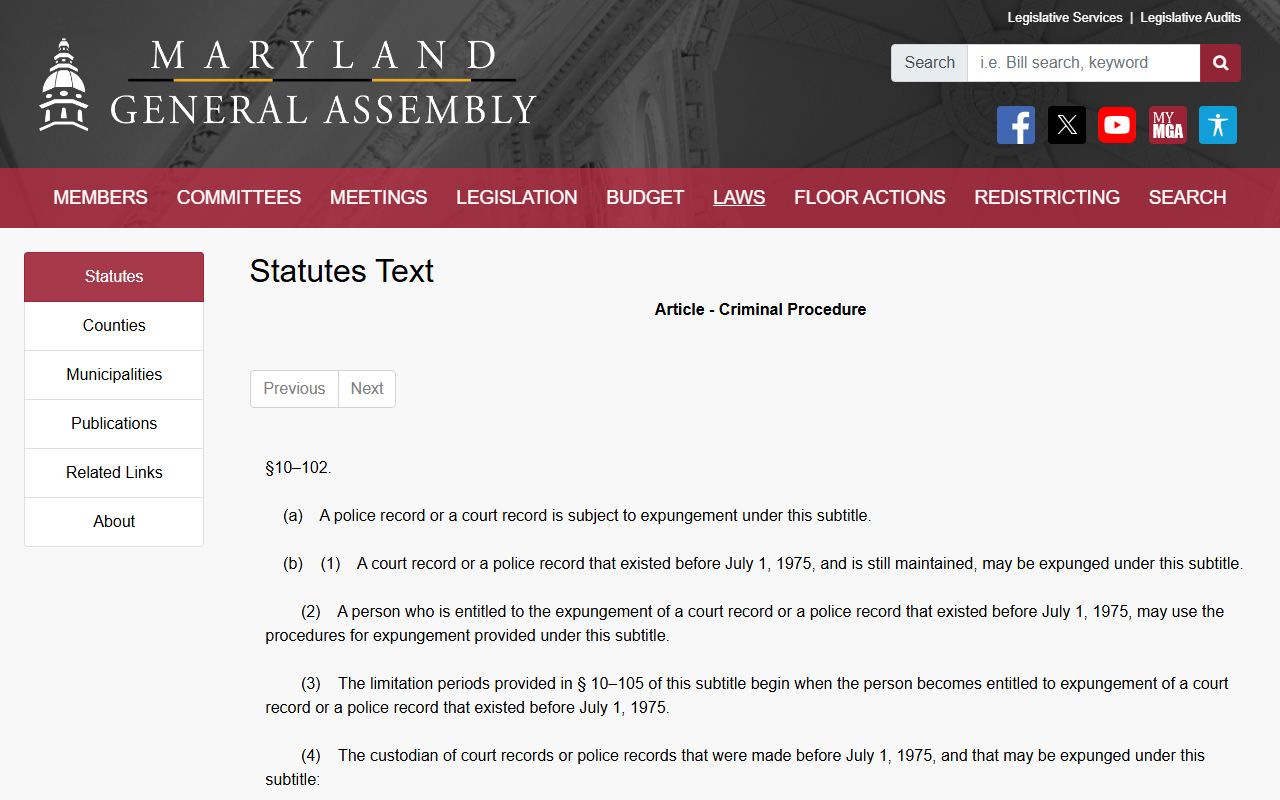
That definition matters because a court docket, police report, citation, charging document, and published opinion may be treated differently under Maryland expungement law.
The official Maryland Criminal Procedure Article section 10-105 source is the main petition expungement section for many non-conviction and eligible outcomes.
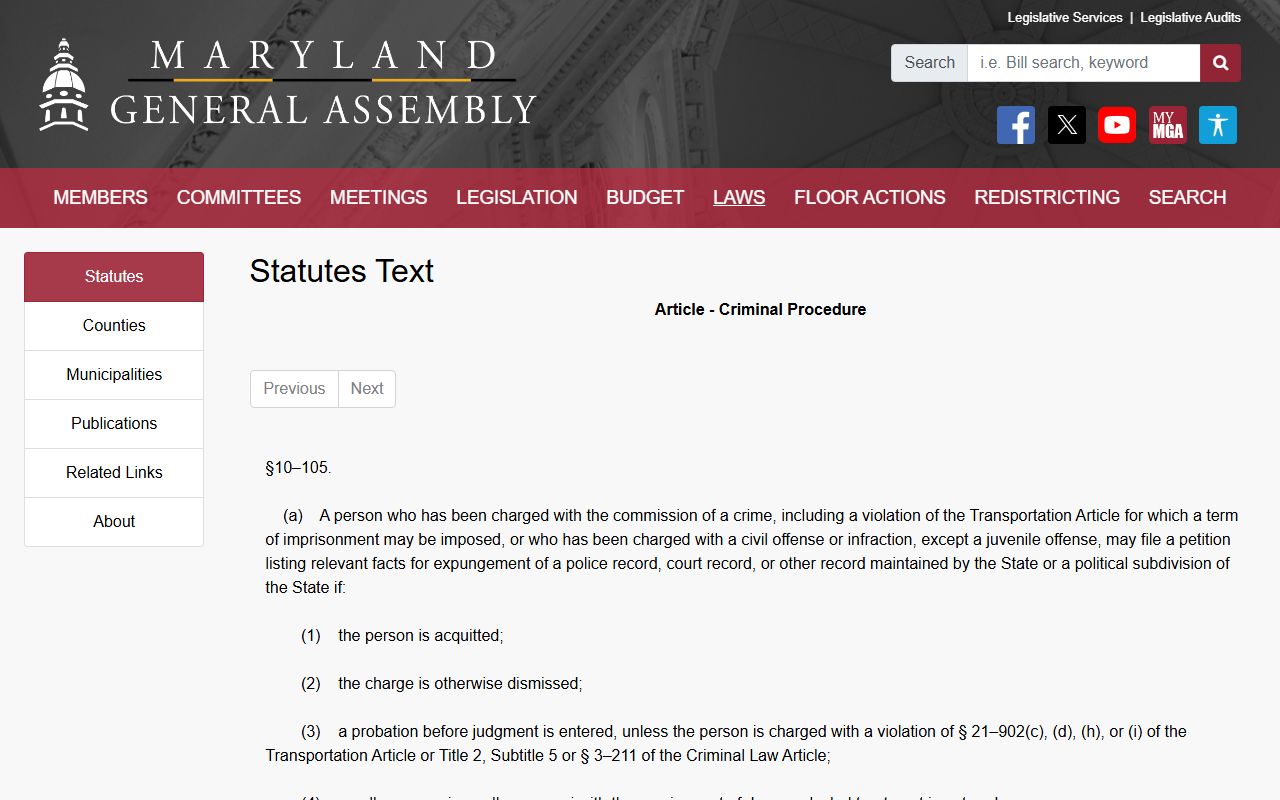
For Charles County cases, an eligible person generally uses the Maryland court expungement process tied to the court record, not a county PIA request.
The official Maryland Criminal Procedure Article section 10-105.1 source covers automatic expungement for certain non-conviction outcomes after three years when the statutory conditions are met.
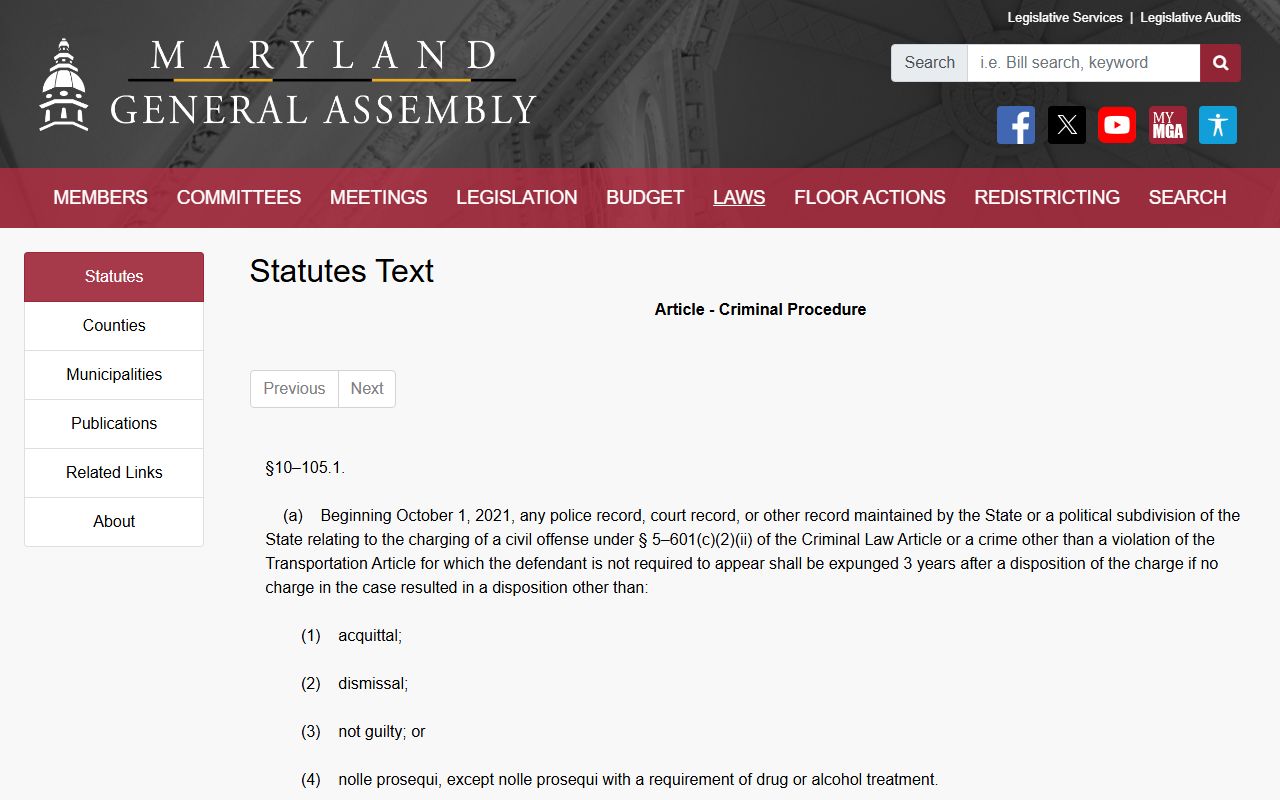
Automatic expungement is not a reason to assume every old dismissed charge has disappeared, so the court record and statute should be checked together.
The official Maryland Criminal Procedure Article section 10-110 source addresses petition expungement for listed convictions with waiting periods that vary by offense.
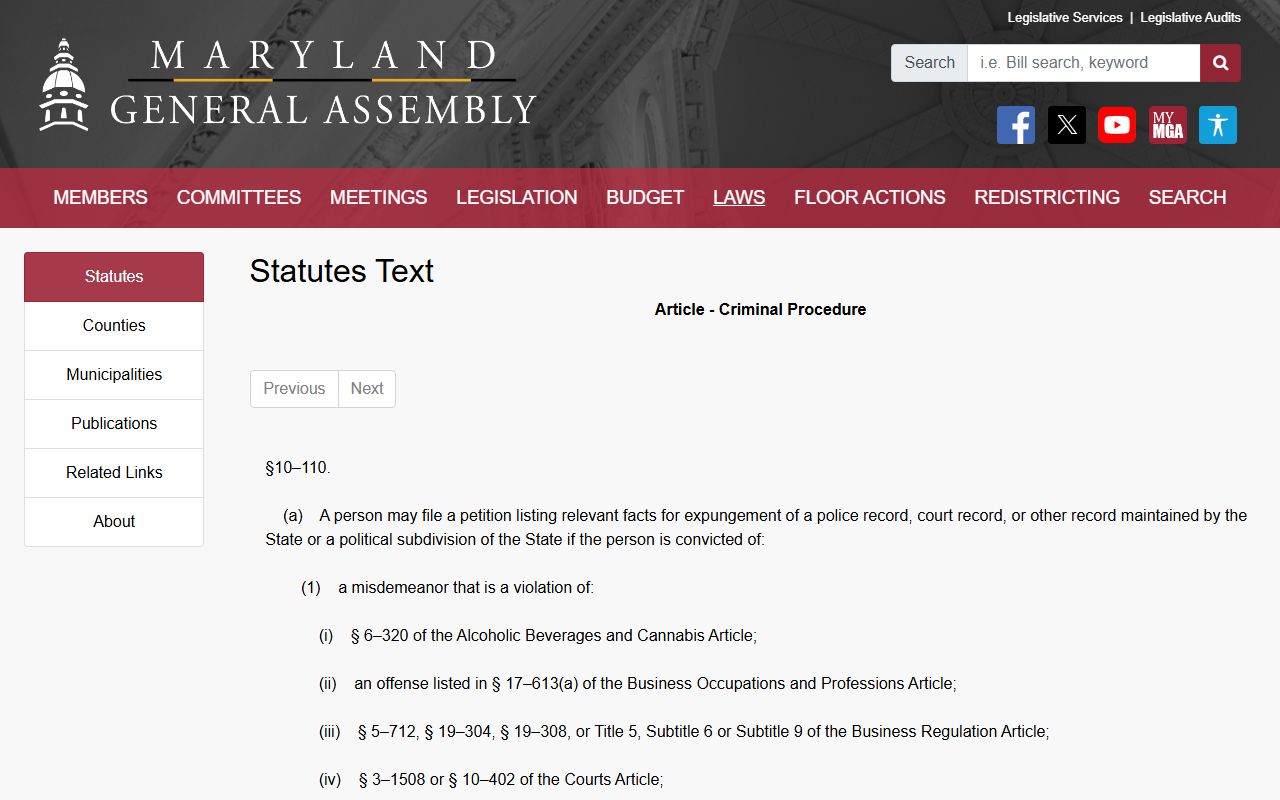
Conviction expungement is narrower than dismissal expungement and depends on the specific offense, waiting period, and case history.
The official Maryland Criminal Procedure Article section 10-301 source defines shielding and lists shieldable convictions.
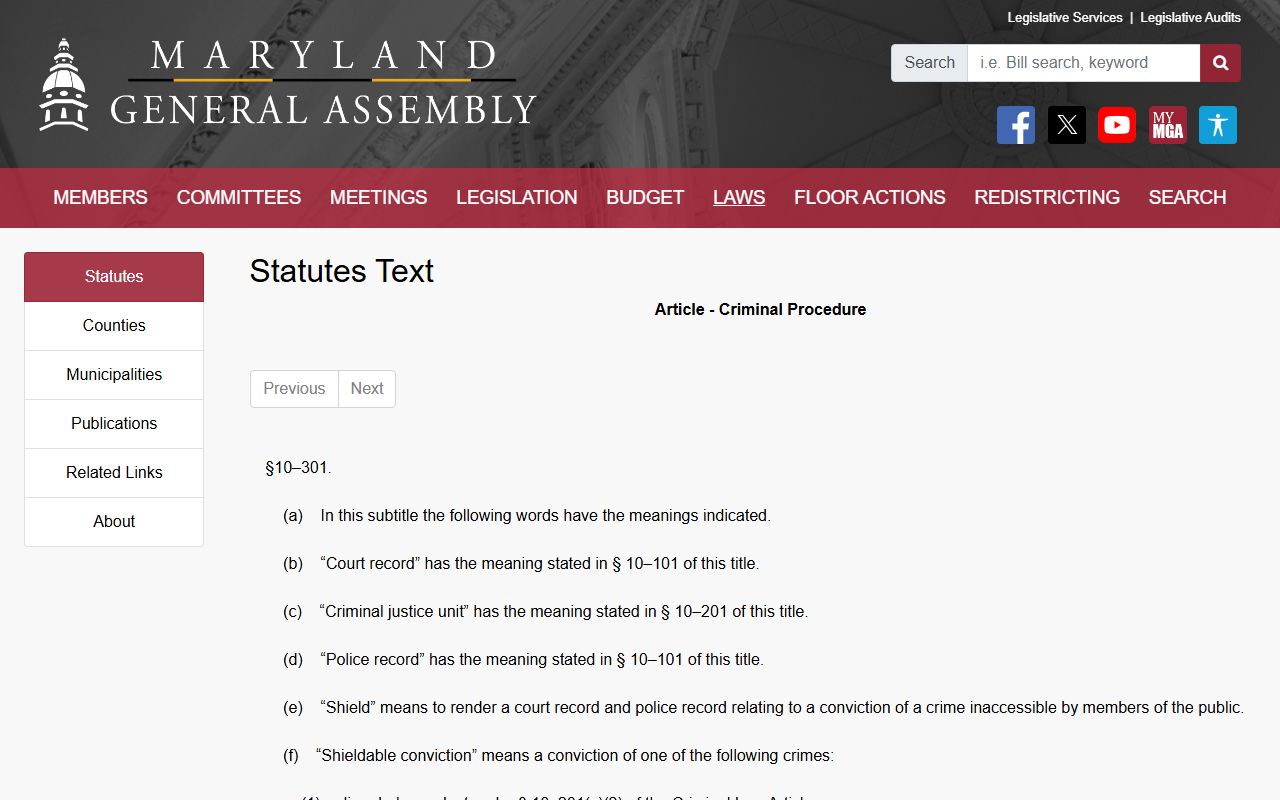
Shielding limits public access to certain records, while expungement removes eligible police and court records from public access under the expungement statute.
| Shielded / Sealed | Expunged | |
|---|---|---|
| Visibility | Hidden or limited from ordinary public access. | Removed from public access under Maryland expungement rules. |
| Maryland Term | Shielding is a Maryland process for certain convictions. | Expungement applies to eligible police and court records. |
| Eligibility | Depends on section 10-301 and related shielding rules. | Depends on sections 10-105, 10-105.1, 10-110, and case outcome. |
Public Access to Criminal Court Records
Maryland court records are handled under judiciary access rules, including Maryland Rules Title 16, Chapter 900. General county PIA requests are not the right path for ordinary criminal court case copies. However, Maryland public-record principles still explain why some government records are open and others are denied. General Provisions Article section 4-201 recognizes the general right to inspect public records unless another law permits or requires denial, while section 4-301 requires denial for privileged or confidential records.
Key point: Use Case Search and the clerk for court records, CCSO for arrest or booking records, and CJIS/DPSCS channels for formal criminal-history checks.
Background Check Considerations
Case Search can be useful for public court research, but the Judiciary FAQ states it is not for criminal background checks. A formal background check needs identity verification and authorized criminal-history records. A name-only court search can miss records, confuse people with similar names, or display charges that are not convictions. For employment, tenant screening, credit, insurance, or licensing use, follow the correct FCRA and Maryland criminal-history process.
Important: Public court lookup is not a substitute for an authorized consumer report or official criminal-history check.
Restricted Criminal Court Records in Charles County
Juvenile delinquency, sealed cases, expunged charges, adoption-related materials, mental health records, protected addresses, victim-sensitive information, active investigative materials, and records restricted by court order may not appear in public Case Search. Arrest reports and investigative files are law-enforcement records and may be denied or redacted when active, juvenile-related, victim-sensitive, medical, confidential, or otherwise protected. If a record does not appear online, the reason may be legal restriction, not proof that no event occurred.