
Charles County Arrest Records and Court Charges
Arrest records in Charles County are law-enforcement records tied to the arrest event, booking process, incident report, arresting agency, and detention status. The Charles County Sheriff's Office is the local law-enforcement agency identified in the research file, with official site ccso.us and non-emergency phone 301-932-2222. The research did not confirm an official public CCSO online inmate roster or public countywide arrest blotter, so arrest and booking detail should be requested or confirmed through official CCSO channels rather than a third-party aggregator.
Court charge records begin when charges are filed in District Court or Circuit Court. They may arise from a police officer's statement of charges, a criminal citation, a prosecutor-filed information, or a grand jury indictment. The State's Attorney's Office for Charles County reviews cases after a crime, determines applicable charges, and handles bail review, investigation, grand jury, trial, and sentencing. Court charges after arrest can be checked through Maryland Case Search and the relevant court clerk, while full outcomes belong with criminal court records and current custody belongs with inmate records.
The official Charles County Sheriff's Office news page is a local law-enforcement source for recent press releases, not a court disposition database.
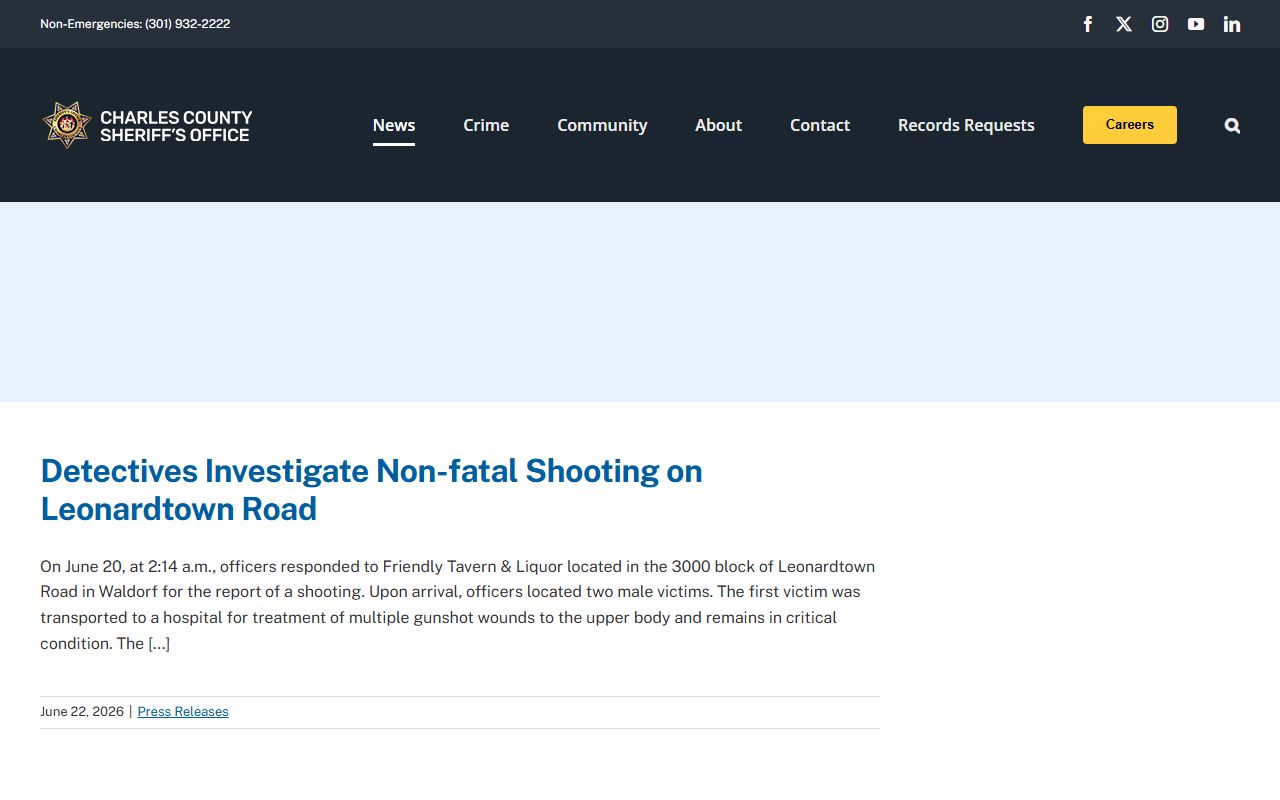
Press releases can explain reported arrests or investigations, but a court record must be checked before treating an accusation as a filed charge or final outcome.
How to Find Charles County Arrest Records and Charges
Start by deciding which record is needed. Arrest or booking detail is not the same as the court charge list. For law-enforcement records, use CCSO official channels and expect redactions or denial for active investigations, juvenile information, victim details, medical information, or confidential law-enforcement material. For court charges, use Maryland Judiciary Case Search and narrow to Charles County, District Court, or Circuit Court. For certified copies, contact the court or clerk that owns the case.
- Use CCSO official contact channels when the need is arrest report, booking information, incident report, or detention confirmation.
- Use Maryland Case Search when the need is filed charges, charge status, hearing dates, disposition, or case number.
- Search by defendant name, case number, or citation number, then narrow by Charles County and court level.
- Open the case and read each charge separately because one arrest can produce several charges with different statuses.
- Contact the Clerk of the Circuit Court, District Court, State's Attorney, OPD, or CCSO only for the record each office actually controls.
The research file notes that no official CCSO app-only arrest, inmate, or warrant lookup was confirmed. If an app appears later, it should be verified through the official CCSO site or app-store publisher details before being treated as a records source.
How Charges Get Filed After an Arrest: Complaint, Information, and Indictment
The arrest comes first in the law-enforcement system. The court record begins when a charging document is filed. Maryland charge records can include the charge text, statute or article reference, count number, case number, filing date, bond status, plea, and disposition. The prosecutor can review, amend, add, reduce, or decline to pursue charges. The official Charles County State's Attorney about page describes the office's role in charge review, bail review, grand jury proceedings, trial, and sentencing.
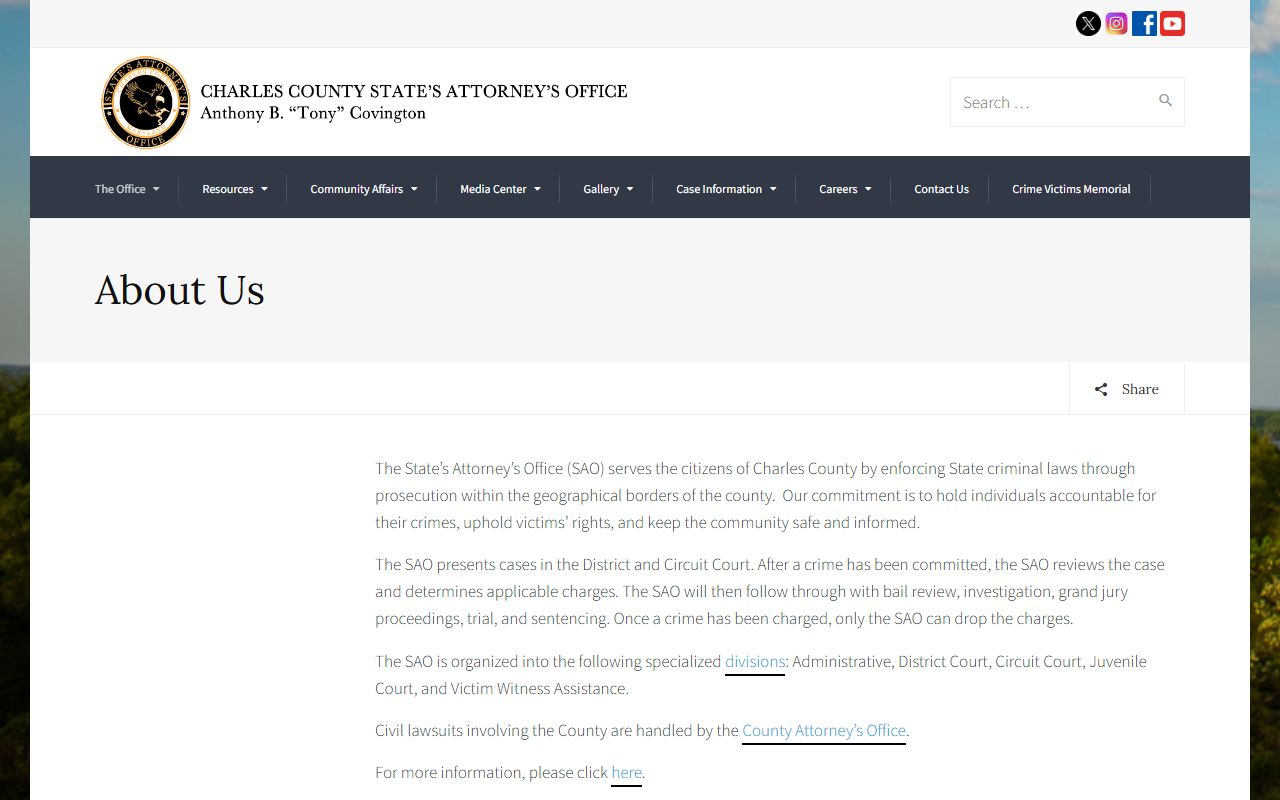
That prosecutor role is why an arresting agency and the final filed court charges may not match one-to-one.
| Complaint / Statement of Charges | Information | Indictment | |
|---|---|---|---|
| Filed By | Officer, commissioner process, or charging authority depending on case path. | State's Attorney. | Grand jury. |
| Common For | Misdemeanors, preliminary proceedings, citations, and initial charges. | Prosecutor-filed criminal charges, including serious matters where permitted. | Serious felony or grand-jury cases. |
| Record Role | Starts or supports the court charge record. | States the prosecutor's filed accusations. | States grand-jury charges for Circuit Court prosecution. |
| Where to Check | Case Search, District Court, Circuit Court, or clerk copy request. | Case Search and Circuit Court clerk channels. | Case Search and Circuit Court clerk channels. |
Charge Status and What It Means
Charge status can change throughout a case. A filed charge may be pending at the first hearing, amended after prosecutor review, reduced during plea negotiation, dismissed by court action, nolle prossed by the State's Attorney, placed on stet, resolved by PBJ, or ended by guilty or not guilty disposition. Always read the status for each count, not just the first charge listed.
| Status | What It Means |
|---|---|
| Pending | The charge is still active and no final public disposition has been entered. |
| Amended / Reduced | The charge text, degree, or count has changed, often after prosecutor review or plea negotiations. |
| Dismissed | The charge has been terminated by court action or procedural result, depending on the docket entry. |
| Nolle Prosequi | The State's Attorney declined to continue prosecution of that charge. |
| Stet | The charge is placed on an inactive docket and may be reopened under conditions. |
| PBJ | Probation before judgment, a Maryland outcome that is not the same as an ordinary guilty conviction entry. |
| Guilty / Not Guilty | The final charge outcome after plea, bench trial, or jury trial. |
Charges vs. Convictions
A court charge is an accusation filed in court. A conviction is a final outcome based on a guilty plea, guilty verdict, or qualifying court finding. Maryland public records can show both, and they should not be collapsed into one label. A person may have an arrest record with no filed charge, a filed charge with no conviction, several charges from one arrest with mixed outcomes, or a conviction that later becomes eligible for shielding or expungement.
| Charge | Conviction | |
|---|---|---|
| Stage | Accusation filed after arrest, citation, information, or indictment. | Final outcome after plea or verdict. |
| Burden of Proof | Charging standard such as probable cause, depending on document type. | Beyond reasonable doubt at trial or admission through plea. |
| Public Record | Often public unless sealed, expunged, juvenile, or otherwise restricted. | Often public unless shielded, expunged, sealed, or restricted. |
| Why It Matters | Shows what was alleged. | Shows what the court finally determined and sentenced. |
Sealed vs. Expunged Records
Charge records can become less visible through sealing, shielding, or expungement, but those are separate concepts. Maryland expungement law includes non-conviction outcomes, some automatic expungement, and listed conviction expungement categories. Shielding is Maryland's term for limiting public access to certain convictions without treating every record exactly like an expunged record. Juvenile, adoption, mental health, and safety-sensitive records can be restricted for other reasons.
The official Maryland Criminal Procedure Article section 10-110 source addresses conviction expungement for listed offenses and waiting periods.
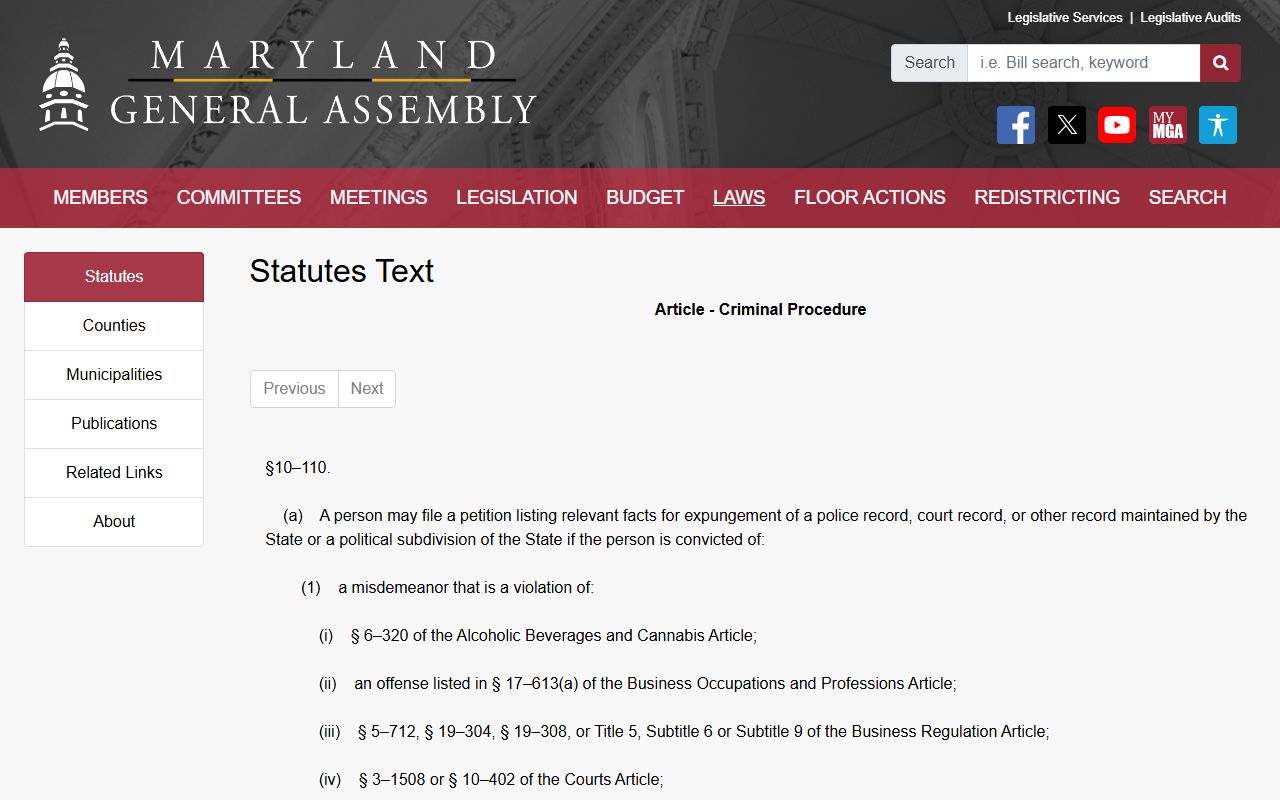
Conviction expungement is narrower than many non-conviction expungement paths and depends on the exact charge and waiting period.
| Sealed / Shielded | Expunged | |
|---|---|---|
| Visibility | Hidden or limited from ordinary public viewing. | Removed from public access under Maryland expungement rules. |
| Common Trigger | Court order, shielding eligibility, juvenile confidentiality, or protected case type. | Eligible dismissal, acquittal, nolle prosequi, PBJ, stet, automatic category, or listed conviction category. |
| Effect on Search | Case or details may not appear publicly, but authorized access may still exist. | Eligible police and court records are removed from public access through the expungement process. |
Charge Codes and Severity Levels
Maryland charge listings usually tie the count to a statute, article, or charge description. A single arrest can produce several counts, and each count can have its own severity level, plea, amended charge, and disposition. Circuit Court generally handles felony prosecutions and jury-trial level criminal matters. District Court handles many misdemeanors, preliminary criminal proceedings, traffic-criminal citations, and limited-jurisdiction criminal matters. Traffic offenses can also be criminal in some situations, and must-appear citations should be read through the District Court traffic and Case Search channels rather than treated like ordinary payable tickets.
Statewide Charge and Criminal History Lookups
Maryland Case Search is useful for court charge lookup, but the Judiciary FAQ says it is not a criminal background-check service. A formal Maryland criminal-history record uses authorized CJIS or DPSCS-supported channels and identity verification. DPSCS also maintains state custody tools and the Maryland sex offender registry, but those are separate from court charges. For a sentenced state inmate, use DPSCS custody lookup. For a Charles County arrest or incident report, use CCSO. For a filed charge, use the court case system. For federal charges, use PACER and the U.S. District Court for the District of Maryland.
The official Maryland Office of the Public Defender Charles County page identifies the local public defender office for eligible criminal and traffic defendants facing possible incarceration.
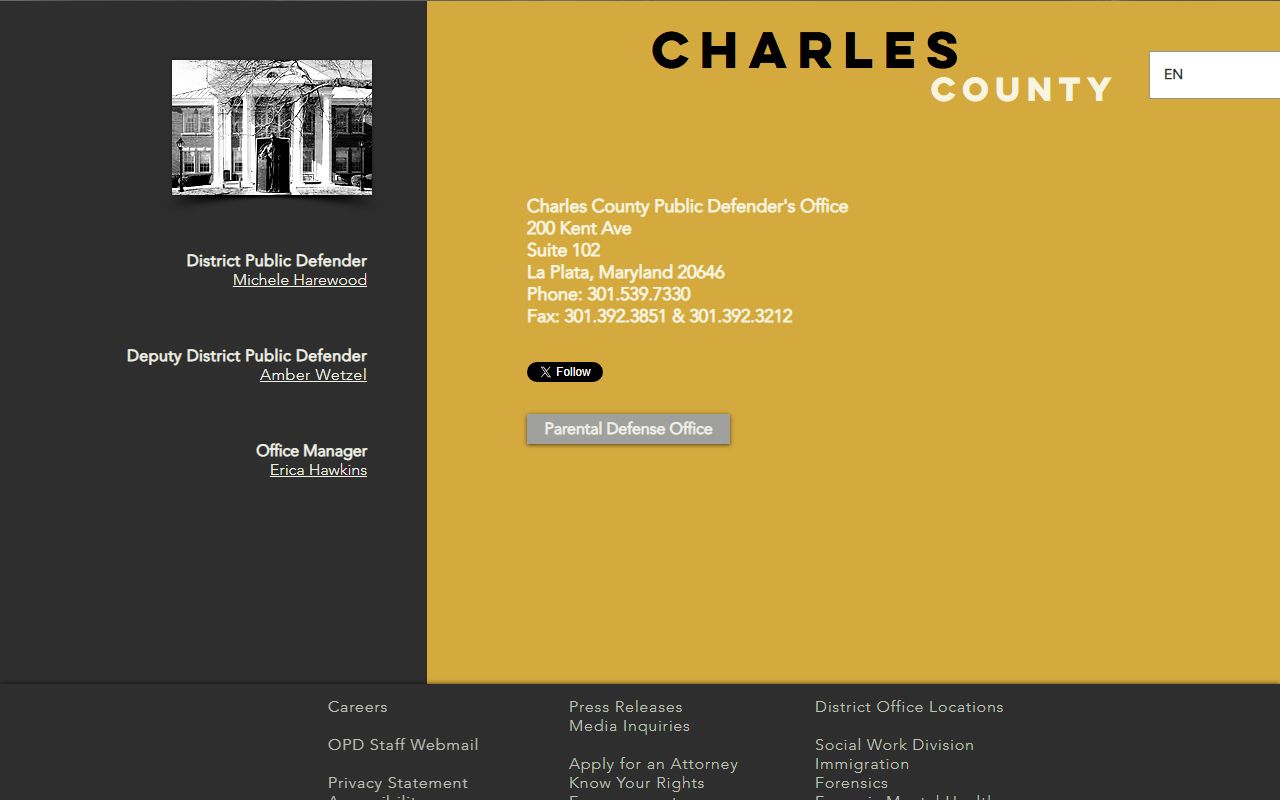
Defense representation is part of the criminal court ecosystem, but OPD is not a public arrest-record search portal.
Background Check Considerations
A name search for arrest records or court charges can mislead if it is used as a background report. It may find a person with a similar name, miss a sealed or expunged case, show a charge that did not result in conviction, or omit the identity verification required for formal screening. For employment, tenant, credit, insurance, or other FCRA-regulated decisions, use an authorized consumer-reporting process and verify records with the originating agency.
Important: Arrest records and filed charges are not the same as convictions or formal criminal-history reports.
Restricted Charge Records in Charles County
Some charge records and arrest-related records are restricted by law, court rule, sealing, expungement, juvenile confidentiality, victim protections, mental health confidentiality, active investigation limits, or safety concerns. CCSO records may be redacted or withheld for law-enforcement reasons. Court charge records may disappear from public search after expungement or may be hidden from ordinary public access after sealing or shielding. If the record is not online, the next step is to contact the office that owns the record rather than assume the event never existed.